









- 09 Nov, 2022
- Software Development
- Business
- By Musketeers Tech
Offshore Software Development: Complete Guide
Offshore software development has evolved from a cost-cutting tactic into a strategic imperative that enables companies to access specialized talent, accelerate product delivery, and scale development capabilities without geographical constraints. The global offshore development market reached $151.9 billion in 2025 and continues growing as businesses recognize that building world-class software requires tapping into worldwide expertise rather than limiting themselves to local talent pools.
This approach to software development transcends simple outsourcing—it represents a fundamental shift in how modern companies build technology products. By establishing offshore development teams in regions like Eastern Europe, Latin America, and Asia, organizations gain access to highly skilled developers with specialized expertise while reducing operational costs by 30-60%. The time zone differences that once seemed like barriers now enable round-the-clock productivity, turning development cycles into continuous workflows that deliver faster results.
What Is Offshore Software Development?
Offshore software development is the practice of outsourcing software creation to third-party teams located in different countries, typically to leverage cost advantages, access specialized skills, and increase development speed through time zone differences. Unlike traditional in-house development or local outsourcing, offshore development involves partnering with teams in distant geographical locations to design, build, test, and maintain software applications.
The offshore software development company model emerged decades ago but has transformed dramatically with advances in communication technology, project management tools, and collaborative development platforms. What began as companies seeking cheaper labor has matured into a sophisticated strategy for accessing global talent pools and building distributed teams that combine the best capabilities from multiple regions.
Modern offshore development encompasses several key areas including web and mobile application development, cloud infrastructure and DevOps, AI and machine learning solutions, enterprise software systems, and product engineering. Major offshore hubs have established themselves in India, Ukraine, Poland, Vietnam, the Philippines, Argentina, and Mexico, each offering distinct advantages in terms of technical expertise, language proficiency, cultural alignment, and cost structure.
Why Companies Choose Offshore Software Development Services
The decision to partner with offshore software development companies stems from multiple strategic advantages that extend far beyond simple cost reduction. Understanding these benefits helps organizations evaluate whether offshore development aligns with their business objectives and technical requirements.
Significant cost savings remain the most immediate benefit, with companies typically reducing development costs by 40-70% compared to hiring equivalent talent locally in North America or Western Europe. These savings result from lower labor costs in offshore regions, reduced overhead for office space and equipment, and the ability to scale teams without long-term employment commitments. However, successful organizations view these savings as enabling investment in more development resources rather than simply cutting budgets.
Access to specialized talent and niche expertise solves the critical problem many companies face: finding developers with specific skills in emerging technologies like blockchain, machine learning, or advanced cloud architectures. Offshore markets provide deep talent pools with expertise that may be scarce or prohibitively expensive domestically. When a company needs five senior React Native developers or three data scientists specializing in natural language processing, offshore development partners can assemble these specialized teams in weeks rather than months.
Scalability and flexibility enable organizations to adapt team size dynamically based on project requirements without the complications of hiring, onboarding, and potentially laying off local employees. Need to expand from five developers to twenty for a major product launch? Offshore partners can scale rapidly. Finished a major release and need to reduce team size temporarily? Offshore models accommodate these changes without employment law complications or morale issues from layoffs.
24/7 development cycles transform time zones from obstacles into advantages when properly managed. While your US-based team sleeps, offshore developers in Asia continue progress on the codebase. This follow-the-sun model can reduce time-to-market significantly, particularly for projects with tight deadlines or rapid iteration requirements. Issues identified at the end of a US workday can be resolved overnight by offshore teams, creating continuous momentum.
Focus on core business activities emerges when technical development responsibilities shift to offshore partners, freeing internal teams to concentrate on strategic initiatives, customer relationships, and competitive differentiation. Rather than building internal development capacity from scratch, companies can leverage offshore expertise while dedicating their energy to what makes their business unique.

Types of Offshore Software Development Models
Offshore development isn’t one-size-fits-all. Different engagement models suit different business needs, project types, and organizational structures. Understanding these approaches helps companies select the arrangement that optimizes outcomes for their specific situation.
Complete project outsourcing transfers entire software development initiatives to offshore teams who manage all phases from requirements analysis through deployment and maintenance. This model works best for companies launching new products without existing technical teams, organizations needing to develop applications outside their core technical competencies, or businesses seeking to minimize involvement in day-to-day development details. The offshore partner assumes full responsibility for delivery, though success requires extremely clear requirements, well-defined acceptance criteria, and strong project governance.
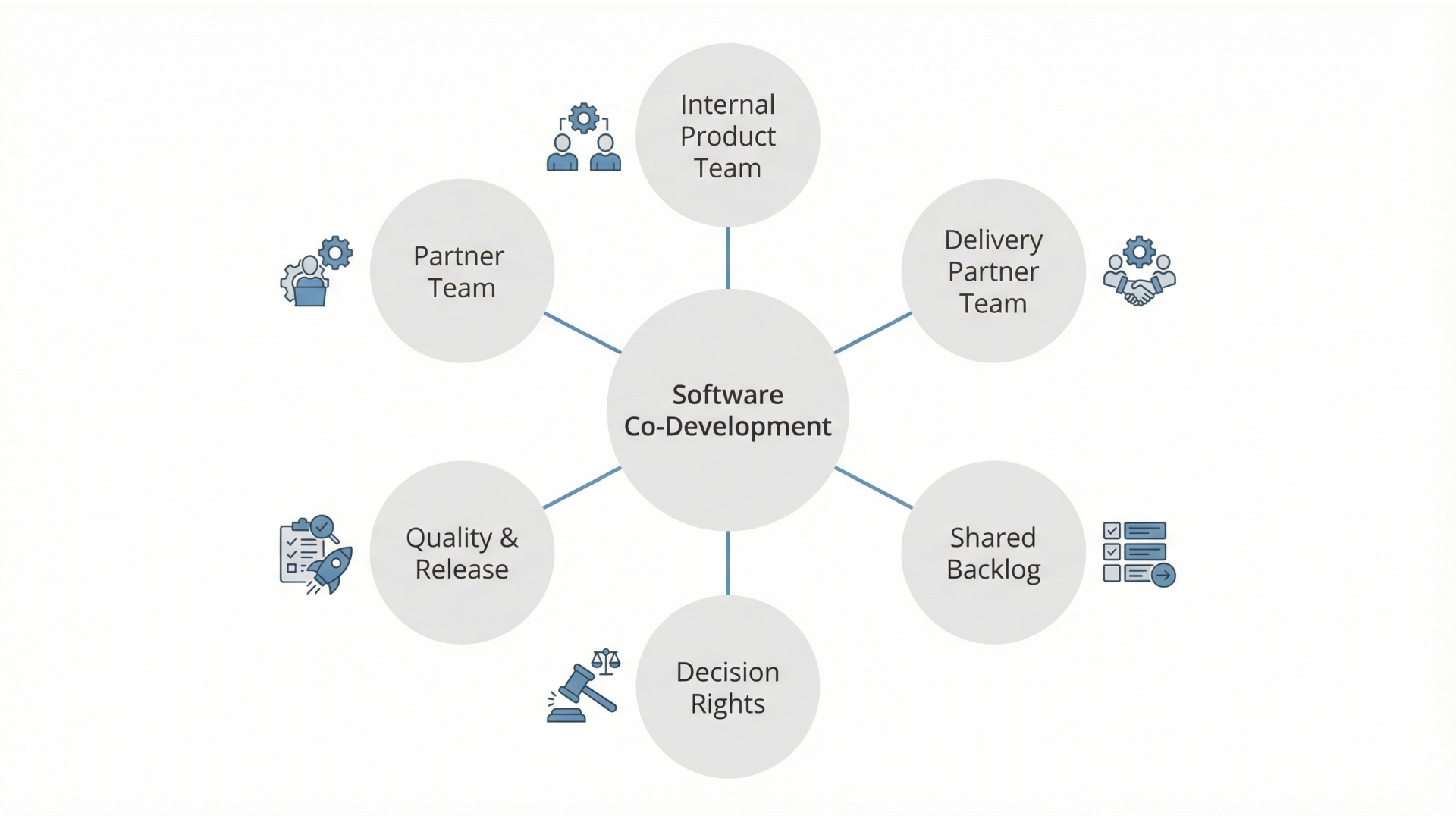
Dedicated offshore development teams function as extensions of your in-house team, working exclusively on your projects under your direction while remaining employed by the offshore partner. This hybrid approach provides the control and integration of in-house development with the cost benefits and scalability of offshore resources. Dedicated teams learn your business, processes, and codebase deeply, creating continuity and institutional knowledge that project-based outsourcing rarely achieves. Companies using this model typically maintain product managers, architects, or technical leads locally while offshore teams handle implementation.
Staff augmentation supplements existing internal teams with individual offshore developers who possess specific skills your team lacks. Rather than outsourcing entire projects, you hire offshore talent to fill gaps—perhaps a senior DevOps engineer to implement your CI/CD pipeline or frontend developers to accelerate your React development. Augmented staff integrate directly into your team, using your tools and processes, but remain employed by the offshore partner who handles payroll, benefits, and HR administration.
Offshore development centers (ODCs) represent the most committed approach, establishing dedicated facilities that function as your company’s offshore branch. Unlike working with third-party vendors, ODCs employ people who work exclusively for your organization, providing maximum control and alignment. This model makes sense for companies with sustained, long-term development needs justifying the investment in dedicated infrastructure, or organizations where data security and intellectual property protection require direct employment relationships.
Hybrid models combine offshore and onshore resources strategically, perhaps keeping architects, product managers, and senior engineers locally while offshore teams handle implementation, testing, and maintenance. This balanced approach leverages the strengths of both models—strategic control and business knowledge remain in-house while execution scales through offshore capacity.
| Model | Best For | Level of Control | Cost Efficiency | Integration Complexity |
|---|---|---|---|---|
| Complete Outsourcing | Defined projects, minimal internal dev team | Low | Highest | Low |
| Dedicated Team | Ongoing development, regular releases | Medium-High | High | Medium |
| Staff Augmentation | Filling skill gaps, temporary needs | High | Medium-High | Low |
| ODC | Long-term commitment, high volumes | Highest | Medium | High |
| Hybrid | Balanced approach, existing teams | Medium | High | Medium |
Building Your Offshore Software Development Team
Successfully establishing offshore development capabilities requires systematic planning and execution. Companies that rush into offshore partnerships without proper preparation often struggle with communication, quality, and alignment issues that could have been prevented.
1. Define Clear Objectives and Requirements
Begin by articulating precisely what you want to achieve through offshore development. Vague goals like “reduce costs” or “develop faster” provide insufficient direction. Instead, specify measurable objectives: “Reduce per-developer costs by 50% while maintaining code quality standards,” or “Launch MVP within 4 months with dedicated offshore team of 6 developers.” Document technical requirements, quality standards, development methodologies you follow, and success criteria for evaluating offshore partner performance.
2. Select the Right Offshore Location
Geography matters significantly in offshore development. Each major offshore region offers distinct advantages and challenges. Eastern Europe (Ukraine, Poland, Romania) provides strong technical skills, European time zone proximity for Western companies, and cultural alignment with Western business practices. India offers the largest talent pool, mature offshore industry infrastructure, and English proficiency, though time zone differences with the US are significant. Latin America (Mexico, Argentina, Brazil) provides cultural similarity and time zone alignment for US companies but generally higher costs than Asia. Southeast Asia (Vietnam, Philippines) combines cost efficiency with growing technical capabilities.
Consider time zone overlap with your core team, English language proficiency if that’s your business language, cultural fit and communication styles, technical skill specialization, and political stability and business infrastructure when evaluating locations.
3. Choose Your Offshore Partner Carefully
The offshore company you select determines your success more than any other factor. Thoroughly vet potential partners by examining portfolios and case studies from projects similar to yours, checking client references with detailed questions about communication, quality, and problem-solving, assessing technical capabilities through code reviews or technical assessments, evaluating project management processes and tools, and understanding their approach to security, intellectual property protection, and compliance.
Red flags include reluctance to provide references, inability to demonstrate relevant technical expertise, vague or inflexible contract terms, lack of established development processes, and poor communication or responsiveness during the sales process.
4. Establish Communication Protocols
Communication challenges sink more offshore projects than technical inadequacies. Establish robust communication frameworks before development begins. Define regular meeting schedules with specific purposes—daily standups for tactical coordination, weekly planning sessions for upcoming work, monthly reviews for strategic alignment. Specify primary communication channels for different purposes, response time expectations, documentation requirements, and escalation procedures for urgent issues or blocked work.
5. Implement Agile Methodologies and Tools
Offshore development requires disciplined process adherence that many in-house teams handle informally. Implement clear agile frameworks (Scrum, Kanban, or hybrid approaches), establish sprint cadences and ceremonies, use collaborative tools for project management (Jira, Asana, Trello), version control (Git with defined branching strategies), documentation (Confluence, Notion), communication (Slack, Microsoft Teams), and code review processes that maintain quality standards while enabling distributed collaboration.
6. Create Strong Technical Governance
Technical oversight prevents the quality erosion that sometimes occurs when development happens outside direct view. Establish architecture review processes, code quality standards and automated enforcement, comprehensive testing requirements, security protocols and audits, and performance benchmarks. Senior technical leaders should maintain regular involvement through architecture discussions, code reviews, and technical planning sessions rather than delegating entirely to offshore teams.
7. Build Team Cohesion and Culture
Distance creates natural barriers to the team cohesion that drives high performance. Deliberately foster connection through occasional in-person meetings when feasible, virtual team building activities, recognition and celebration of successes, knowledge sharing sessions, and inclusive practices that make offshore team members feel valued rather than isolated. Successful companies treat offshore developers as team members rather than vendors, investing in relationships that create mutual commitment.
8. Measure Performance and Iterate
Establish clear metrics for evaluating offshore development effectiveness, including code quality measures (bug rates, technical debt, test coverage), velocity and productivity indicators, schedule adherence, cost performance against budgets, and stakeholder satisfaction. Review these metrics regularly and adjust processes, communication, or even team composition when results don’t meet expectations. Continuous improvement applies to offshore relationships as much as software development itself.

Common Challenges and Proven Solutions
Even well-planned offshore engagements encounter predictable challenges. Understanding these obstacles and their solutions helps organizations navigate difficulties effectively rather than abandoning offshore approaches when problems emerge.
Communication barriers and language differences create misunderstandings about requirements, design decisions, and technical approaches despite English proficiency. Solution: Invest in clear written documentation that captures decisions and requirements, use visual communication (diagrams, mockups, prototypes) alongside verbal explanations, allow extra time for complex technical discussions, and consider providing English language training for offshore teams. Successful companies over-communicate rather than assuming understanding.
Time zone differences complicate synchronous collaboration, delay responses to urgent questions, and can slow decision-making. Solution: Establish core overlap hours when both teams work simultaneously for critical discussions, use asynchronous communication effectively with detailed context in messages, document decisions thoroughly so work continues despite time differences, and rotate meeting times occasionally so inconvenient hours don’t always fall on the same team.
Quality control and code standards sometimes suffer when development happens remotely without constant oversight. Solution: Implement automated code quality checks (linting, static analysis), require comprehensive code reviews before merging, establish clear acceptance criteria for all work, use pair programming or remote collaboration tools for complex features, and conduct regular technical audits. Prevention through process beats correction after problems emerge.
Cultural differences affect work styles, communication preferences, and expectations around hierarchy, feedback, and decision-making. Solution: Provide cultural training for both onshore and offshore teams, establish explicit norms for your team rather than assuming shared understanding, encourage questions and clarifications without judgment, and adapt management approaches to cultural context while maintaining necessary standards.
Intellectual property and security concerns require careful attention when code and sensitive data leave your direct control. Solution: Establish comprehensive legal agreements covering IP ownership and confidentiality, implement technical security measures (VPNs, access controls, encrypted communication), conduct security audits of offshore partner facilities and practices, and restrict access to sensitive systems based on need. Never rely solely on trust—verify security practices rigorously.
Scope creep and requirement changes become more problematic offshore where casual conversations don’t naturally adjust direction. Solution: Use formal change management processes, maintain detailed backlogs with clear priorities, distinguish between requirements changes (which need approval) and clarifications (which don’t), and build flexibility into contracts and budgets for inevitable adjustments while avoiding constant scope expansion.
Team turnover and knowledge retention can reset progress when offshore developers leave and their knowledge departs with them. Solution: Document critical technical knowledge systematically, use knowledge sharing sessions to spread understanding across team members, include redundancy in team structure so multiple people understand each system area, and establish contractual terms addressing transition support when personnel change.
Cost Analysis: Understanding Offshore Development Pricing
Offshore development costs vary significantly based on location, skill level, engagement model, and project complexity. Understanding pricing structures helps set realistic budgets and evaluate proposals effectively.
Hourly rate ranges by region provide baseline comparisons. Eastern Europe typically charges $30-75 per hour for mid-level developers and $60-120 for senior talent. India ranges from $18-50 for mid-level and $40-90 for senior developers. Latin America falls between $30-70 (mid-level) and $50-100 (senior). Southeast Asia offers $20-50 (mid-level) and $40-80 (senior). These ranges fluctuate based on specific countries within regions, technical specializations (AI/ML, blockchain, or niche frameworks command premiums), and individual company reputations.
Total cost considerations extend beyond hourly rates. Factor in communication overhead (management time coordinating offshore work), quality assurance (testing and bug fixing often increase initially), knowledge transfer (time spent onboarding offshore teams), and infrastructure costs (tools, licenses, security). Effective offshore engagements typically achieve 50-60% total cost savings rather than the 70% implied by pure hourly rate comparisons.
Hidden costs catch unprepared companies by surprise. These include legal and contract expenses, travel for relationship building and alignment, time spent on vendor management and coordination, and rework from misunderstandings or quality issues. Budget conservatively for the first 6-12 months as teams establish working relationships and processes.
Pricing models structure financial arrangements differently. Time and materials billing charges actual hours worked, providing flexibility but less predictability. Fixed price projects define scope and cost upfront, shifting risk to vendors but requiring extremely clear requirements. Dedicated team models combine monthly retainers for team resources with flexibility to adjust team size periodically. Outcome-based pricing ties compensation to delivered results but requires sophisticated metrics and trust. Each model suits different project types and organizational preferences.
Cost optimization strategies maximize offshore value without compromising quality. Start with smaller pilot projects to establish processes before scaling, invest in communication and relationship building that prevents expensive mistakes, use offshore for implementation while keeping architecture and critical decisions in-house, establish clear quality standards that prevent costly rework, and adjust team composition as projects mature (more senior resources for architecture, more junior for implementation).
Top Offshore Software Development Regions
Understanding regional strengths helps companies select offshore locations aligned with their specific needs and constraints.
Eastern Europe has emerged as a premium offshore destination combining strong technical education, cultural affinity with Western business practices, and reasonable costs. Countries like Ukraine, Poland, and Romania produce large numbers of computer science graduates with solid theoretical foundations and practical experience. The region excels in complex system architecture, fintech applications, and enterprise software. Time zones overlap partially with both US and Asian markets. Political instability in some areas and higher costs than Asia represent potential drawbacks.
India remains the world’s largest offshore market with unmatched scale and infrastructure. Major cities like Bangalore, Pune, and Hyderabad house massive development operations with decades of offshore experience. India’s talent pool covers virtually every technology and specialization. English proficiency is generally strong, though accents sometimes challenge communication. Significant time zone differences from the US require adjustment. Cost competitiveness and mature processes make India ideal for large-scale projects.
Latin America provides nearshore advantages for US companies with overlapping time zones enabling real-time collaboration. Countries like Mexico, Argentina, and Brazil offer strong technical capabilities with cultural similarities to the US. English proficiency varies but continues improving. Costs fall between Eastern Europe and Asia. The region suits companies valuing synchronous communication and cultural alignment over maximum cost savings.
Southeast Asia, particularly Vietnam and the Philippines, combines cost efficiency with rapidly improving technical capabilities. These markets offer English language skills (especially the Philippines with American cultural influence) and strong work ethics. The region excels in mobile development, web applications, and quality assurance. Infrastructure and political stability exceed most expectations. Growing but still emerging technical ecosystems mean specialized expertise may be harder to find than in more mature markets.
Emerging markets like Egypt, Pakistan, and African countries present frontier opportunities with very low costs but higher risks regarding infrastructure, political stability, and process maturity. These destinations suit adventurous companies willing to invest in building capabilities in exchange for cost advantages and early market positioning.
Best Practices for Offshore Development Success
Organizations that consistently achieve positive offshore outcomes follow patterns that can be replicated.
Start small and scale gradually rather than immediately offshoring critical projects or large teams. Begin with well-defined, lower-risk projects that allow both teams to establish working relationships, communication patterns, and processes before expanding. Success builds confidence and organizational buy-in while failures remain contained and educational.
Invest heavily in the beginning through in-person kickoffs when possible, comprehensive onboarding and knowledge transfer, clear documentation of systems and processes, and explicit communication norms. The time and money spent establishing strong foundations pays dividends throughout the engagement.
Treat offshore developers as team members rather than external vendors. Include them in team meetings and decisions, recognize their contributions publicly, invest in their professional development, and create opportunities for in-person interaction. Developers who feel valued deliver better work and remain engaged long-term.
Maintain technical ownership by keeping critical architecture decisions, core intellectual property, and strategic technical direction with in-house teams or trusted offshore partners you’ve worked with extensively. Offshore teams should implement well-defined solutions rather than defining technical strategy without deep business understanding.
Use the right tools for distributed collaboration including robust project management platforms, comprehensive documentation systems, quality version control with clear workflows, automated testing and deployment, and communication tools that support both synchronous and asynchronous interaction. Invest in tool training for offshore teams.
Build for timezone overlap by structuring work so offshore teams can make progress independently rather than constantly requiring real-time input. Provide clear requirements and acceptance criteria, document architectural decisions and context, enable autonomous decision-making within defined parameters, and save synchronous time for complex discussions requiring interactive exploration.
Measure what matters through objective metrics rather than activity indicators. Focus on delivered features, code quality standards, customer-impacting bugs, and team velocity trends rather than hours worked or lines of code written. Quality metrics motivate better practices while activity metrics encourage busy work.
Plan for turnover by building knowledge redundancy into teams, documenting tribal knowledge systematically, using pair programming to spread critical expertise, and establishing knowledge transfer expectations in contracts. Offshore developer retention exceeds industry averages when companies invest in relationships, but some turnover is inevitable.

The Future of Offshore Software Development
Offshore development continues evolving as technology, economics, and global dynamics shift. Understanding emerging trends helps companies position themselves advantageously.
Distributed teams as the norm rather than exceptional arrangements will characterize future software development as companies realize that exceptional talent distributes globally. Remote collaboration tools and practices developed during the COVID-19 pandemic normalized distributed work, reducing the distinction between offshore and other remote arrangements. Companies will increasingly hire wherever the best talent exists rather than limiting searches to specific geographies.
AI and automation augmentation will transform offshore development productivity through AI-assisted coding tools that accelerate implementation, automated testing and quality assurance, intelligent project management that identifies risks early, and natural language processing that reduces communication barriers. Rather than replacing offshore developers, these tools will make them more productive and effective.
Specialized expertise hubs will emerge as particular regions develop concentrations of specialized skills. Just as Bangalore became synonymous with Indian IT, specific cities may become known for blockchain development, AI research, fintech expertise, or other specializations. Companies will select offshore partners based on specific expertise rather than general development capabilities.
Outcome-based pricing models will gain prominence as measurement and management practices mature. Rather than billing hours or retaining teams, offshore engagements will increasingly tie compensation to delivered business value, product performance, or other outcome metrics. This shift requires sophisticated measurement but aligns incentives more effectively.
Security and compliance focus will intensify as data protection regulations expand globally and cyber threats increase. Offshore partners will need to demonstrate rigorous security practices, compliance with various international standards, and sophisticated data governance. Companies will invest more in vetting and auditing offshore security.
Nearshore preference may increase for some organizations as they balance cost savings against communication complexity and time zone alignment. The premium for nearshore development in Latin America or Eastern Europe over Asian offshore may shrink as companies value real-time collaboration and cultural alignment.
Platform and AI companies will abstract offshore arrangements through automated team formation, intelligent project routing, and outcome guarantees that make offshore engagement as simple as purchasing SaaS products. These platforms will handle partner selection, team assembly, and project management while ensuring quality through AI monitoring and automated intervention.
Frequently Asked Questions
What is the difference between offshore, nearshore, and onshore software development?
Offshore development involves partnering with teams in distant countries, typically on different continents with significant time zone differences. Nearshore development works with teams in neighboring countries with similar time zones and often cultural affinity—for example, a US company working with teams in Mexico or Canada. Onshore development keeps all work within the same country. The primary differences involve time zone overlap, travel distance for in-person meetings, cultural and language alignment, and cost. Offshore typically offers maximum cost savings but greatest communication complexity, nearshore balances cost and convenience, while onshore provides easiest collaboration but highest costs.
How much does offshore software development really cost?
Total offshore development costs typically range from $30-150 per hour depending on region, experience level, and technical specialization. Eastern European developers cost $40-100/hour on average, Asian developers $20-70/hour, and Latin American developers $40-90/hour. However, hourly rates represent only part of total cost. Factor in communication overhead, management time, initial onboarding investment, and potential quality issues. Most companies achieve 40-60% cost savings compared to hiring equivalent US-based talent rather than the 70-80% that pure hourly rate comparisons suggest. Hidden costs in the first few months of establishing offshore relationships often surprise unprepared organizations.
How do I find and vet reliable offshore software development companies?
Start by clearly defining your requirements, technical needs, and project parameters. Research potential partners through platforms like Clutch, GoodFirms, or industry-specific directories. Request detailed proposals from 3-5 candidates. Evaluate partners by reviewing portfolios of similar projects, speaking with multiple client references asking specific questions about communication, quality, and problem resolution, conducting technical assessments or code reviews, meeting potential team members who would work on your project, and discussing project management approaches and tools. Red flags include reluctance to provide references, inability to demonstrate relevant expertise, vague or inflexible contracts, poor responsiveness during sales, and promises that seem unrealistic. Take time in selection—choosing the right partner matters far more than starting quickly.
What are the biggest risks of offshore software development and how can they be mitigated?
Primary risks include communication breakdowns leading to misunderstood requirements, quality issues from inadequate oversight, intellectual property concerns, security vulnerabilities, cultural misalignments, and dependency on specific individuals who may leave. Mitigate these risks by establishing clear communication protocols with redundant channels, implementing automated quality checks and regular code reviews, securing comprehensive legal agreements covering IP and confidentiality, conducting security audits of partner facilities, investing in cultural training for both teams, and building knowledge redundancy across team members. Start with lower-risk projects to test relationships before committing critical work. Most importantly, select partners carefully and invest in relationships rather than treating offshore teams as disposable resources.
How long does it take to establish a successful offshore development team?
Timeline varies significantly based on project complexity and organizational readiness. Expect 2-4 weeks for partner selection and contracting, 2-4 weeks for team recruitment and formation by the offshore partner, 2-4 weeks for onboarding and knowledge transfer, and 4-8 weeks for the team to reach productive velocity. Most offshore relationships require 3-6 months to stabilize and demonstrate value, with peak performance emerging after 6-12 months as teams deeply understand your business, technology, and processes. Companies that rush integration or expect immediate productivity usually experience disappointment. Plan for gradual ramp-up and invest in proper foundations.
Transform Your Development Capacity with Strategic Offshore Partnerships
Offshore software development represents far more than a cost-cutting measure—it’s a strategic approach that expands your organization’s technical capabilities, accelerates product development, and provides flexibility to scale resources dynamically based on business needs. Companies that approach offshore development strategically, investing in relationships, processes, and communication, consistently achieve remarkable results including 40-60% cost reductions, access to specialized expertise unavailable locally, and faster time-to-market through expanded development capacity.
Success requires moving beyond transactional vendor relationships to build genuine partnerships with offshore teams who understand your business, share your quality standards, and contribute strategic value beyond simply writing code. The organizations winning with offshore development treat offshore developers as valued team members, invest in communication and relationship building, maintain appropriate technical oversight, and continuously refine processes based on results and feedback.
Whether you’re exploring offshore development for the first time or looking to optimize existing offshore relationships, the key principles remain consistent: start with clear objectives and realistic expectations, select partners carefully based on capabilities and cultural fit, invest heavily in foundations through onboarding and process establishment, treat offshore teams as partners rather than vendors, and measure outcomes while continuously improving based on data and feedback.
Ready to explore how offshore software development can accelerate your product roadmap while optimizing costs? Musketeers Tech specializes in building and managing high-performing offshore development teams tailored to your specific technical requirements and business objectives. Contact us today to discuss how strategic offshore partnerships can transform your development capabilities and competitive position.
